
May 4 Commemoration
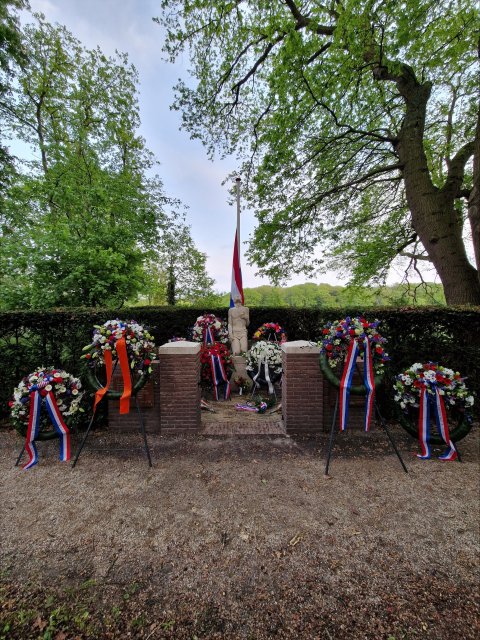
On Monday, May 4, a memorial service was held in Wassenaar at the monument on Schouwweg. The service began with a silent procession to the monument from the corner of Nachtegaallaan and Schouwweg. Several guests laid wreaths. The service was accompanied by the Excelsior Music Association of Wassenaar.
You can read Mayor Leendert de Lange's speech below.
Speech by Mayor Leendert de Lange
Tonight we have gathered together, in silence and solidarity. To commemorate those who fell victim to World War II, the colonial war in Indonesia, and subsequent conflicts or peacekeeping missions. First and foremost, I think of the 574 people who died in Wassenaar, including 99 Jewish residents. Fathers and mothers, brothers and sisters, uncles and aunts, and children, who lost their lives under the tyranny of the occupiers. Scarred by this immense loss, their family members picked up the pieces of their lives; I think of them. I also think of our other fellow villagers who experienced the horrors firsthand and for whom the war continues in their minds and hearts, even in subsequent generations. So here we are together, at the monument of the Dying Warrior. How wonderful that you are here tonight. We owe a debt of profound gratitude to the Canadians, Americans, British, French, and Poles who liberated us. Often young people, conscripted soldiers. They risked their lives against oppression and for our freedom.
One of the civilians who lost their lives was Cornelis Rietbergen of Wassenaar, captain of the merchant ship De Amstelland.
When the Nazis invaded, our government-in-exile decreed that the merchant fleet must remain available to supply frontline soldiers with weapons, oil, and food—the “duty to sail.” As a result, the merchant fleet became a crucial lifeline for Dutch soldiers.
But in this way, the merchant seamen themselves became frontline soldiers. For years they were away from home, under constant threat from German and Japanese torpedoes and bombers. 400 ships were sunk, and 3,500 conscripted sailors lost their lives, including Captain Rietbergen, a forgotten naval hero.
After the war, there was hardly any recognition for the conscripted sailors. Not for their powerlessness, not for their mortal fear, and not even for their contribution to the Allied victory.
My grandfather was also a seaman. He was lucky to be back home in safe harbor just before the war broke out. His employer made sure he didn’t have to set sail. On his first voyage shortly after the liberation, he was supposed to take—frail children—the “pale-faced ones” from the city to England. Things turned out differently. On a voyage from Antwerp to Rotterdam, his ship, the Christiaan Huygens, was severely damaged off the coast of Vlissingen. It struck a sea mine. My grandfather scrambled up from the engine room. With his arm dislocated, pinned under a string tied around his much-too-loose overalls. He miraculously survived. Otherwise, my mother—who is here today—would have lost her father, and I would have lost my grandfather.
Everyone has their own memories of the war. In a moment, Riet Ruijgrok’s three grandchildren will read aloud from their grandmother’s wartime diary. As a 12-year-old girl, she experienced the German invasion at 159 Oostdorperweg, where her father was a bulb grower.
How could that war have started—the war that claimed the lives of Captain Rietbergen, my grandfather, Mrs. Ruijgrok, and so many others? How was it possible that 6 million Jews were murdered, 100,000 of them from the Netherlands? It was simply decided at a conference table, recorded in the minutes, and carried out.
How was it possible that people with disabilities, Roma, Sinti, gay people, Jehovah’s Witnesses, and political dissidents were also discriminated against, labeled as dangerous, and then deported and murdered, simply because of who they were? Fear of the occupiers stifled any resistance. Those who dared to stand up often paid for it with their lives. Yes, we can judge with the knowledge we have today. But let’s not hold the ordinary people of that time to a black-and-white standard.
Let’s learn from history. By listening. To the generation that lived through the war. To people with personal stories. Could it happen again? That’s what people today are asking themselves.
Every day, we witness the horrors of war in Ukraine and the Middle East. And even now, Jews are increasingly being intimidated and threatened. Even today, people sometimes live in their own little bubbles and aren’t always looking to connect. Polarization, intolerance, and exclusion are always lurking.
8.5 million Dutch households received the information booklet “Prepare for an Emergency.” “We are in a low-intensity conflict in peacetime,” says the government. People realize that it could happen again, after all. Can we do anything about it ourselves? Yes! Take a look at the SIRE campaign featuring the two figures: “Don’t lose each other when polarization draws near.” A call for tolerance—accept that we are, after all, different.
I also say: don’t think in terms of “us versus them,” but listen to those who think differently, and be curious about what motivates them. And don’t remain indifferent; stand up to those who polarize and exclude others, and step out of your comfort zone.
Fortunately, Wassenaar is blessed with a vibrant community life. 10,000 volunteers are active in education, sports, the church, and other organizations. There is tremendous strength in this, and it makes us a resilient community. The most recent King’s Day celebration was yet another celebration of our shared sense of community.
Soon, the eighth-grade students at Herenweg School will lay a wreath they made themselves. To commemorate the suffering of World War II. But also for the future. During the guest lecture I had the privilege of giving on war, remembrance, and freedom, I saw how deeply they cared. They, too, see wars between world leaders and the suffering of innocent people all over the world. In the beautiful song “Two Minutes of Silence” by Kinderen voor Kinderen, they sing: “You can be whoever you want to be, you can believe what you believe; together we are stronger with our hands joined.” That is what they wish for Wassenaar, the Netherlands, and the world.
I, too, hope that we may all live by this, each within our own circle.
Let’s not forget, and let’s make sure it never happens again.