New Rules for the Power Grid
Starting July 1, 2026, the rules governing the use of the power grid will change. This will affect residents and businesses.

Changes for Residents
Power Grid at Capacity: New Rules Mean Households Will Also Have to Wait Longer for Power
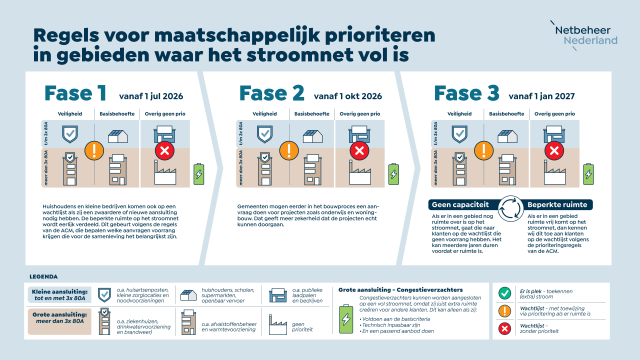
Starting July 1, 2026, the rules governing the use of the power grid will change. This will affect residents who want to make their homes more sustainable or increase their electricity capacity in areas where the power grid is reaching capacity. This is happening in an increasing number of regions. As a result, the available capacity will be allocated differently going forward.
What will change?
Until now, households have almost always been provided with a (higher-capacity) electricity connection immediately when they needed one. That is changing. Under new national rules from the regulator ACM, everyone—including households—in areas where the power grid is at capacity will be placed on a waiting list if the grid is full. Check your grid operator’s power grid checker to see if this applies to your area:
From now on, the available capacity on the grid will be allocated according to a so-called prioritization framework. Under this framework, priority will be given first to projects that contribute to:
- Increasing capacity on the power grid (e.g., energy storage)
- Safety and critical services (such as hospitals and emergency services)
- Basic services such as housing and education
Only then are other requests considered. Households are therefore given priority if capacity is available, but only after capacity has been allocated to projects that are given higher priority. This means that residents sometimes have to wait longer for, for example, a new or higher-capacity connection.
What does this mean for you as a resident?
- An additional connection or increased capacity (for example, for a charging station or heat pump) is no longer a given.
- In high-demand areas, an application may be placed on a waiting list.
- How long you'll have to wait depends on the situation in your area. This could take several years.
Check how busy the power grid is in your region using your grid operator’s grid checker.
Important: Your current electricity connection will continue to work as usual.
What is still allowed?
Even when the power grid is at full capacity, there are often more options than you might think. Grid operators advise households to first explore solutions within their existing connection:
Check your current connection and plans
Many households can carry out their plans without incurring additional costs. Check out the options on the grid operators’ websites:
Use Electricity More Wisely
- Spread out the use of appliances (for example, don't use the washing machine and the charging station at the same time)
- Use timers or apps to avoid peak usage
Choose smart solutions
- Smart charging stations or energy management systems automatically coordinate devices with one another.
Get some advice
- An installer can help you adapt your plans to fit your current connection.
Why this change?
Demand for electricity is growing rapidly due to the energy transition: electric cars, heat pumps, and solar panels are causing spikes in consumption. The power grid is being expanded, but that takes time. That is why decisions must be made to allocate the available capacity fairly.
What is the municipality of Wassenaar doing?
The Municipality of Wassenaar is working with utility companies to expand the power grid and help residents with smart solutions. At the same time, we’re asking residents to be mindful of their electricity usage and to carefully plan any home renovations and sustainability improvements.
Changes for Businesses
New rules for the power grid: greater impact on businesses
Starting July 1, 2026, businesses will face longer wait times for new or higher-capacity electricity connections. Due to growing pressure on the power grid, new national rules will apply to the allocation of scarce capacity.
What will change?
Whereas previously only businesses with large connections were placed on a waiting list in areas where the steam grid was at capacity, this now applies much more broadly. Small and medium-sized businesses and other companies with smaller connections (up to 3x80A) will also be affected by this.
If there is capacity, the available grid capacity is allocated according to the social prioritization framework. This means:
- First, projects that relieve or expand the grid (congestion-relief measures)
- Next, critical sectors (e.g., Health, safety)
- Next, basic services (such as housing and education)
- Other companies will follow in the order in which they applied
For businesses that are not given priority—including many small and medium-sized enterprises—this means they are more likely to end up on a waiting list and will only receive funding once the parties given priority have received theirs. Waiting times can vary significantly by region.
Impact on Businesses
- Expanding, electrifying, or making your business more sustainable may be delayed
- New locations or charging infrastructure aren't always immediately feasible
What is still allowed?
Despite the limitations, there are still several options:
Check your current connection and plan ahead
- Many upgrades can be done without immediately increasing the load. Check out the options on the grid operators' websites:
- Ask an installer for advice
Optimize Your Energy Usage
- Spread out tasks throughout the day
- Actively monitor energy consumption
Invest in flexibility
- Energy Storage (Batteries)
- Smart Control of Systems
- Flexible contracts with the utility (for an upgraded or high-consumption connection)
Collaborate throughout the supply chain
Collaboration in industrial parks (such as shared storage or peak load balancing) can create capacity.
What does this mean for your business plans?
The availability of electricity is becoming a key factor in growth and investment. Companies would be wise to:
- to take energy into account early on in the site selection process and expansion plans
- develop scenarios for limited grid capacity
- contact the utility company and the installer in a timely manner
Moving Forward Together
Grid operators are investing heavily in expanding the grid, but demand is growing faster than capacity. As an industry association, we urge companies to anticipate this now. By using energy more efficiently and planning ahead, development and sustainability will remain possible—even during periods of scarcity.